
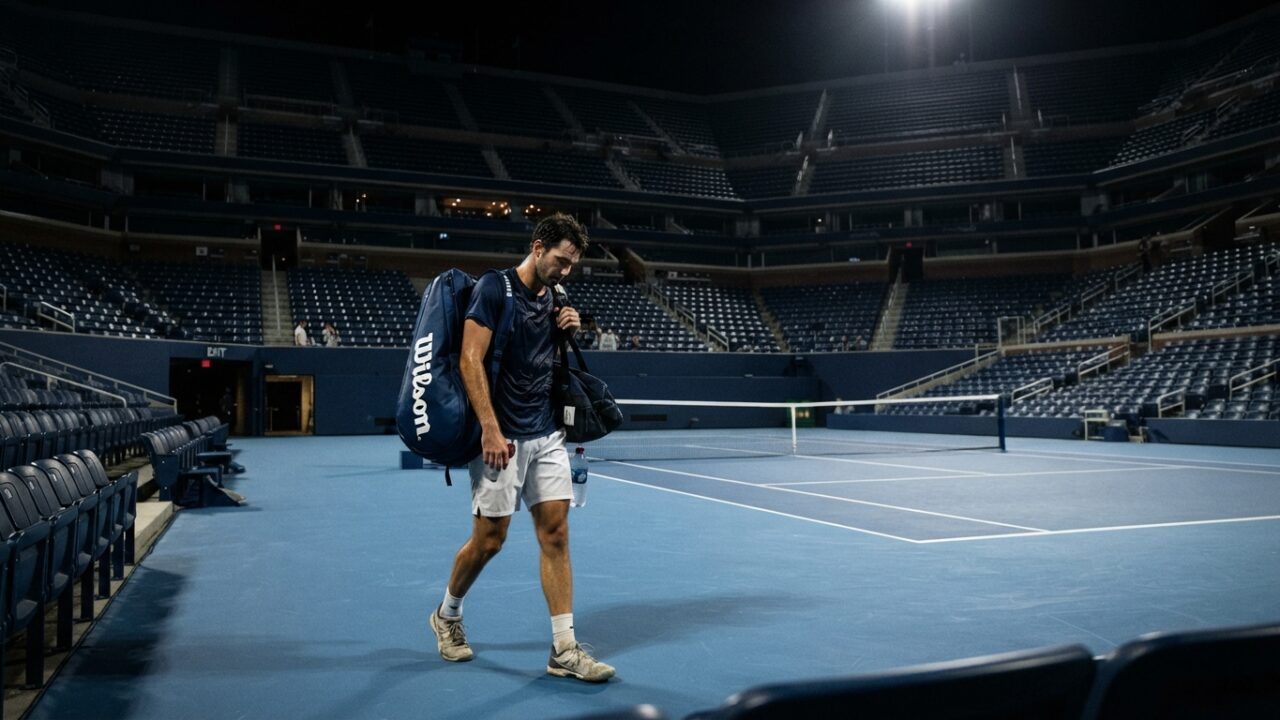
Novak Djokovic suffered a shocking third-round exit from the US Open, losing to Argentina’s Mariano Navone in what the Serbian described as one of the most harrowing nights of his career. The defeat marks a rare early departure for the 24-time Grand Slam champion, who entered the tournament as one of the favorites despite recent struggles.
The loss extends Djokovic’s challenging 2025 season, raising questions about his form and future as he approaches his 38th birthday. Navone, ranked outside the top 50, delivered a performance that stunned the Arthur Ashe Stadium crowd and sent shockwaves through the tennis world.
Uncharacteristic struggles on hard court
Djokovic appeared unable to find his rhythm throughout the match, committing uncharacteristic errors and struggling with his usually reliable serve. The Serbian won only a handful of break point opportunities and failed to impose the mental pressure that has been his trademark during two decades at the top of men’s tennis.
Navone, by contrast, played with freedom and precision, keeping Djokovic pinned behind the baseline and capitalizing on short balls. The 23-year-old Argentine showed no signs of intimidation facing one of the sport’s greatest champions, maintaining his aggressive baseline game through the crucial moments.
The match lasted over three hours, with Djokovic appearing increasingly frustrated as the night progressed. His body language suggested both physical and mental fatigue, a stark contrast to the composed champion who has won four US Open titles.
Pattern of concerning results
This latest setback follows a difficult season for Djokovic, who has struggled to recapture the dominance that saw him win three Grand Slam titles in 2023. He entered the US Open without a major championship this year, having fallen short at the Australian Open, French Open, and Wimbledon.
The Serbian’s coaching changes and schedule adjustments have failed to reverse his declining results. His movement appeared labored at times during the Navone match, raising questions about whether age and accumulated injuries are finally catching up with a player who has defied conventional wisdom about athletic longevity.
Djokovic’s previous earliest US Open exit came in 2006, when he lost in the third round as a teenager. The contrast between that young player full of potential and the veteran struggling to maintain his standards could not be more pronounced.
Navone seizes career-defining opportunity
For Navone, the victory represents the biggest achievement of his professional career. The Argentine had never before reached the fourth round of a Grand Slam tournament and entered the match with limited hard-court credentials, having built his game primarily on South American clay.
His tactical discipline and nerve under pressure impressed observers. Navone constructed points patiently, refused to overhit when serving for the match, and showed the composure of a far more experienced player when facing break points at critical junctures.
The win propels Navone into the second week of a major for the first time and guarantees a significant rankings boost. He will face either an unseeded opponent or a lower seed in the fourth round, giving him a realistic path to the quarterfinals.
Implications for tennis hierarchy
Djokovic’s defeat opens the draw considerably for the remaining title contenders. Carlos Alcaraz and Jannik Sinner, the two young stars who have emerged as the faces of tennis’s next generation, now have one fewer obstacle in their path to the championship.
The result also fuels speculation about Djokovic’s future schedule and priorities. With the 2025 season now lacking a Grand Slam title, the Serbian faces difficult questions about his training regimen, coaching setup, and whether he can rediscover the physical and mental edge that defined his career.
Some analysts have suggested Djokovic may need to adopt a more selective tournament schedule, focusing his preparation solely on the majors rather than attempting to compete week after week as he did in his prime years.
Historical context of late-career struggles
Djokovic joins a list of all-time greats who experienced sudden declines after extended periods of dominance. Roger Federer and Rafael Nadal both faced similar questions about their ability to compete at the highest level as they entered their late thirties.
However, Djokovic’s situation differs from his rivals in key respects. He has avoided the chronic injuries that plagued Nadal and has maintained a more robust physical condition than Federer showed in his final years. This makes his recent struggles more puzzling to tennis observers who expected him to remain competitive for several more seasons.
The mental aspect of maintaining motivation after achieving everything the sport offers also cannot be discounted. Djokovic has spoken about finding purpose beyond statistics and records, but translating that philosophy into sustained performance has proven difficult.
Tournament continues without defending presence
The US Open moves into its second week without one of its most successful champions. Djokovic’s absence from the latter stages creates opportunities for emerging players and changes the dynamics of the men’s draw considerably.
Tournament organizers and broadcasters face the challenge of maintaining interest without one of tennis’s biggest stars. Djokovic’s matches have consistently drawn the highest television ratings and ticket prices, making his early exit a significant commercial loss.
The remaining players, however, welcome the opportunity to compete without facing Djokovic in the semifinal or final rounds. His psychological dominance over much of the field has been well-documented, and his absence removes that intimidation factor entirely.
Questions remain unanswered
Djokovic declined to provide extensive commentary immediately after the match, leaving observers to speculate about his physical condition and future plans. Whether he will make coaching changes, adjust his training methods, or reconsider his tournament calendar remains unclear.
The tennis world now waits to see whether this represents a temporary setback or the beginning of a permanent decline for one of the sport’s most accomplished champions. Djokovic has repeatedly proven doubters wrong throughout his career, but the challenges he faces at this stage appear more fundamental than in previous difficult periods.