
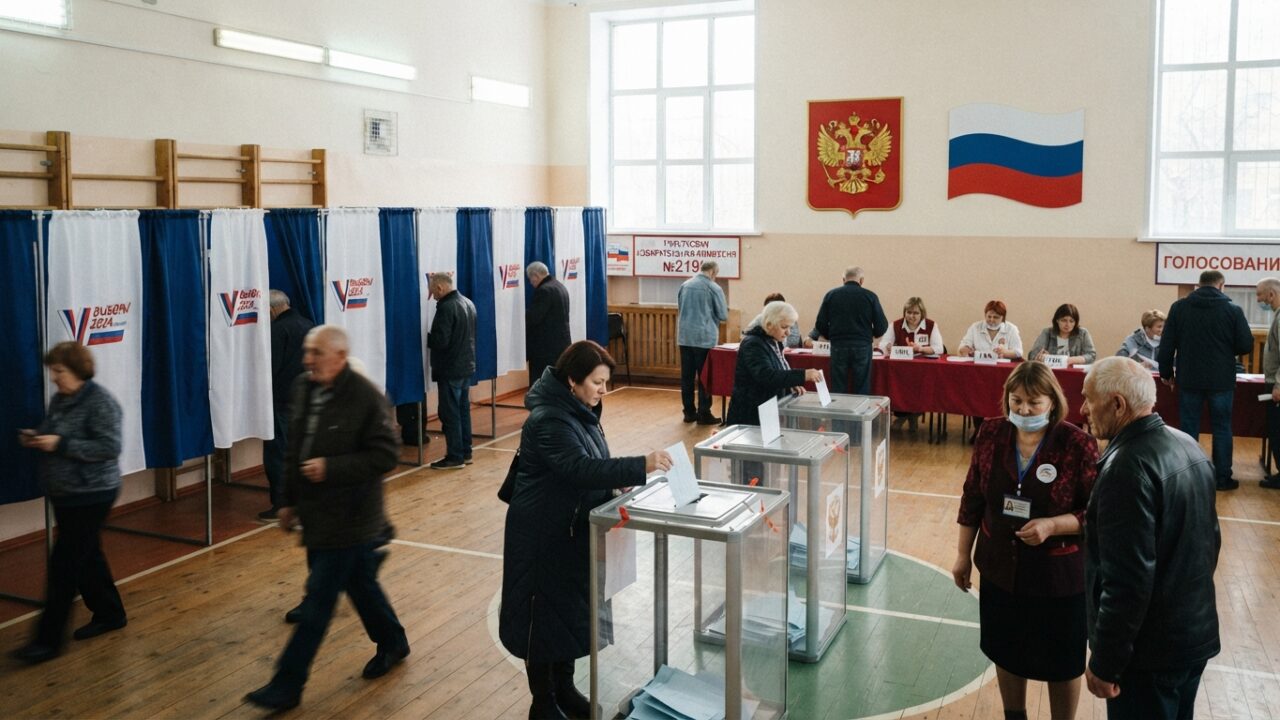
Russians are casting ballots in parliamentary elections taking place under wartime conditions, with the vote widely expected to strengthen the Kremlin’s already formidable control over the legislative branch. The election unfolds against a backdrop of military mobilization, media censorship, and the systematic elimination of political opposition.
The State Duma elections represent the first major electoral test since Russia launched its full-scale invasion of Ukraine in February 2022. With virtually all independent political voices either imprisoned, exiled, or banned from participating, the outcome appears predetermined in favour of parties loyal to President Vladimir Putin.
Controlled electoral environment
The voting process spans multiple days, a practice that international observers have criticized as creating opportunities for manipulation. Polling stations opened across Russia’s eleven time zones, with authorities promoting the elections as a demonstration of democratic legitimacy even as opposition groups denounce them as a sham.
The ruling United Russia party, which already holds a constitutional supermajority in the Duma, faces no significant challengers. Three other parties represented in parliament — the Communist Party, the Liberal Democratic Party, and A Just Russia — all support the war effort and pose no genuine opposition to Kremlin policies.
Independent election monitoring has become virtually impossible. Golos, Russia’s most respected election watchdog, was forced to cease operations after being designated a foreign agent. International observers from the Organization for Security and Cooperation in Europe have not been invited to monitor the vote.
Opposition silenced or scattered
The political landscape has been systematically cleared of dissenting voices. Alexei Navalny, Putin’s most prominent critic, died in February 2024 in an Arctic penal colony while serving a lengthy prison sentence on charges widely viewed as politically motivated. His organization was banned and labeled extremist, making participation in its activities a criminal offense.
Many opposition politicians and activists have fled Russia to avoid prosecution under laws that criminalize criticism of the military or the spread of what authorities deem false information about the armed forces. Those who remain face severe legal consequences for political activity that deviates from official narratives.
New candidates loyal to the Kremlin have emerged to fill vacancies, often emphasizing patriotic themes and support for Russian forces. The electoral commission has barred candidates who expressed even mild criticism of government policies, ensuring that only approved voices appear on ballots.
Wartime propaganda dominates campaign
Campaign messaging has centered overwhelmingly on support for what Russian authorities call the special military operation in Ukraine. State media has provided extensive favorable coverage to pro-government candidates while ignoring or denigrating alternative viewpoints.
Authorities have presented the election as a test of national unity in the face of what they characterize as Western aggression. Officials have framed voting as a patriotic duty, linking participation in the election to support for Russian troops fighting in Ukraine.
The military conflict has provided justification for expanded restrictions on political activity and free expression. Laws enacted since the invasion began carry prison sentences of up to fifteen years for actions deemed to undermine the armed forces or spread false information about military operations.
Online voting raises manipulation concerns
Electronic voting has expanded significantly, with officials promoting online balloting as a convenient alternative to in-person voting. Critics warn that the lack of transparency in digital voting systems creates additional opportunities for manipulation beyond those already present in traditional paper ballot processes.
The extended voting period, officially justified as a pandemic-era health measure that has been maintained, allows multiple days for ballots to be cast. Election integrity advocates argue this practice makes it virtually impossible to ensure secure ballot custody and creates windows for fraudulent votes to be introduced.
Previous elections have been marred by documented instances of ballot stuffing, carousel voting schemes where individuals vote multiple times, and statistical anomalies suggesting result manipulation. With monitoring mechanisms dismantled, detecting such irregularities has become more difficult.
Regional variations and pressure tactics
Voting is taking place in occupied territories of Ukraine that Russia claims to have annexed, a process that Ukraine and Western governments refuse to recognize as legitimate. Electoral authorities have organized voting in these areas despite ongoing military operations and the absence of conditions necessary for free expression of popular will.
Reports have emerged of pressure on government employees, students, and military personnel to participate in voting, with some employers allegedly requiring proof of participation. Such coercive practices have characterized previous Russian elections, but monitoring groups say enforcement has intensified.
In some regions, particularly those bordering conflict zones, authorities have emphasized security concerns to justify additional restrictions on campaign activities and observer access to polling stations.
International response and implications
Western governments have indicated they will not recognize the elections as free or fair, citing the systematic exclusion of opposition voices and the impossibility of genuine political competition under current conditions. The European Union and United States have both issued statements questioning the legitimacy of votes conducted without basic democratic safeguards.
The election outcome will likely be used by Russian authorities to claim domestic legitimacy for continued prosecution of the war and for policies that have isolated Russia from much of the international community. A strong showing for United Russia would provide Putin with additional political cover for potentially unpopular decisions, including further mobilization if military conditions require it.
The newly constituted Duma will face decisions about wartime budgets, economic policies under sanctions, and potential negotiations over the conflict’s future. With opposition eliminated, the parliament will function primarily as a rubber stamp for executive decisions rather than as a genuine deliberative body.
Final results are expected to be announced in the days following the close of polling, with United Russia projected to maintain or expand its dominance. What remains uncertain is not the outcome, but rather how authorities will use the manufactured mandate to shape Russia’s trajectory as the war continues with no clear endpoint in sight.
