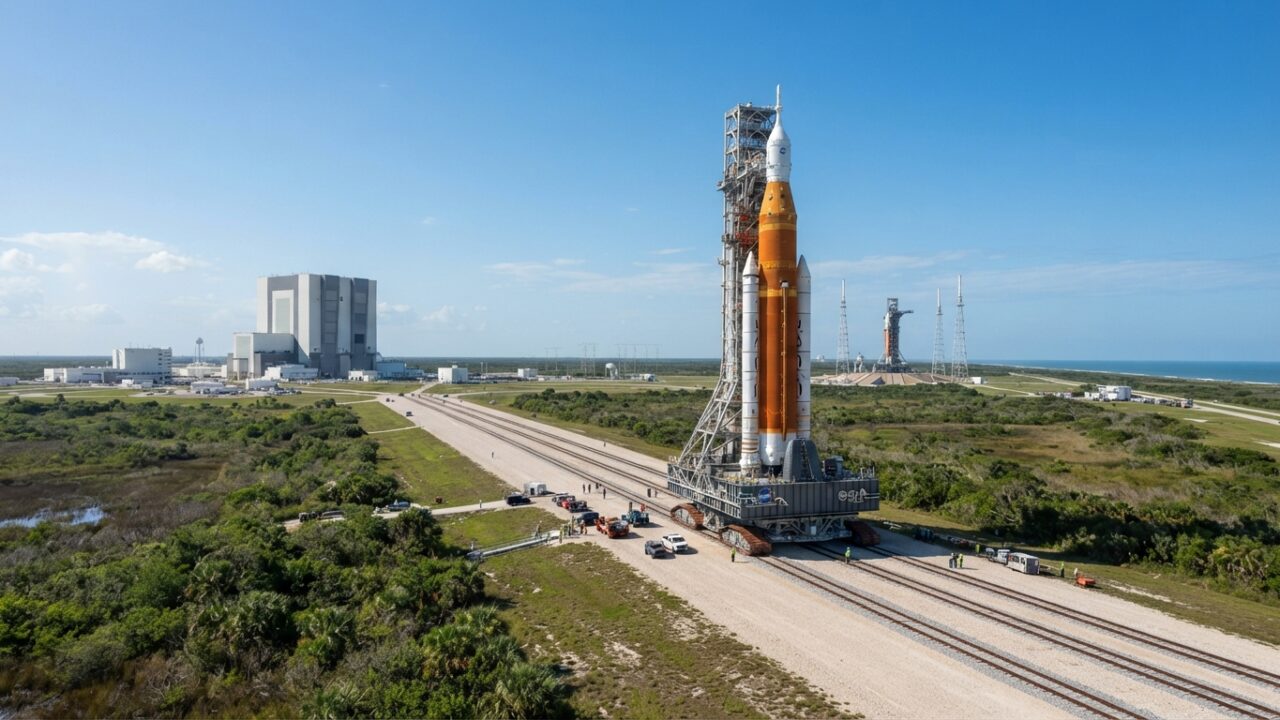
NASA’s Nancy Grace Roman Space Telescope has reached a pivotal moment in its journey to orbit, with mission teams confirming the observatory and its SpaceX Falcon Heavy launch vehicle have been transported to the launch pad at Kennedy Space Center in Florida. The move positions the telescope for final preparations before what promises to be one of the most significant astronomical missions of the decade.
The Roman Space Telescope, named after NASA’s first chief astronomer who championed the development of space-based observatories, represents a next-generation infrared observatory designed to answer fundamental questions about dark energy, exoplanets, and the structure of the universe. Its arrival at the launch complex signals the culmination of years of development and the beginning of intensive final checks.
Technical Capabilities and Mission Objectives
The telescope carries a 2.4-meter primary mirror, identical in size to the Hubble Space Telescope, but with a field of view approximately 100 times larger than Hubble’s infrared instrument. This wide-field capability allows Roman to survey vast areas of space with unprecedented efficiency, capturing images covering areas equivalent to the apparent size of 100 full moons in a single observation.
Mission planners have designed Roman with two primary instruments. The Wide Field Instrument will conduct surveys across infrared wavelengths, while the Coronagraph Instrument will demonstrate technology for directly imaging exoplanets by blocking starlight. These capabilities position the telescope to conduct large-scale surveys that would take decades using current observatories.
The spacecraft’s primary scientific goals include mapping dark energy’s influence on cosmic expansion, conducting a comprehensive census of exoplanets through gravitational microlensing, and surveying infrared light across the universe. Scientists expect the mission to discover thousands of exoplanets and observe billions of galaxies during its planned operational lifetime.
Launch Vehicle and Mission Architecture
SpaceX’s Falcon Heavy, one of the world’s most powerful operational rockets, will deliver Roman to its operational orbit. The heavy-lift launcher, which consists of three Falcon 9 first-stage cores strapped together, provides the thrust necessary to place the approximately 4,000-kilogram observatory into its planned trajectory.
Following launch, Roman will travel to the second Lagrange point, approximately 1.5 million kilometers from Earth in the direction opposite the Sun. This gravitationally stable location, also home to the James Webb Space Telescope, provides an ideal environment for infrared observations, offering thermal stability and unobstructed views of deep space.
The journey to this operational position typically requires several weeks of orbital maneuvers and trajectory corrections. Once positioned, mission teams will conduct an extensive commissioning phase, testing instruments and aligning optical systems before beginning science operations.
Pre-Launch Testing and Verification
Before the rollout to the launch pad, the telescope underwent exhaustive environmental testing to ensure survival of launch stresses and the harsh conditions of space. Engineers subjected the observatory to vibration testing simulating launch forces, acoustic testing replicating the intense sound environment during liftoff, and thermal vacuum testing to verify performance in the extreme temperatures of space.
The spacecraft also completed final integration with its launch vehicle adapter, the mechanical interface connecting the telescope to the Falcon Heavy upper stage. This connection must withstand launch forces while providing clean separation once the desired orbit is achieved.
Scientific Legacy and Context
The Roman Space Telescope builds on a scientific legacy stretching back decades. Its namesake, Nancy Grace Roman, played a crucial role in developing the Hubble Space Telescope and advocating for astronomical research from space platforms. Her work laid groundwork for generations of space-based observatories that have transformed understanding of the cosmos.
The mission arrives at a critical juncture in cosmological research. Observations over recent decades have revealed that dark energy drives the accelerating expansion of the universe, yet its fundamental nature remains mysterious. Roman’s wide-field surveys aim to measure this expansion with unprecedented precision across cosmic history, potentially revealing whether dark energy’s strength has changed over time.
In exoplanet research, Roman will complement other missions by using gravitational microlensing, a technique that detects planets when their gravity briefly magnifies light from background stars. This method proves particularly effective for finding planets at greater distances from their stars than techniques like transit observations, filling gaps in current knowledge about planetary system architecture.
Economic and International Dimensions
The mission represents a substantial investment in fundamental science, with development costs reflecting the complexity of building cutting-edge space instrumentation. NASA manages the project through its Goddard Space Flight Center, with contributions from numerous aerospace contractors and research institutions across the United States.
International collaboration enhances the mission’s scientific value. While NASA leads the project, partnerships with space agencies and research organizations worldwide will maximize the scientific return from Roman’s observations. Data from the mission will be made available to the global astronomical community, enabling researchers everywhere to pursue discoveries.
Timeline and Operational Planning
Launch preparations now enter their most intensive phase. Teams will conduct final vehicle checks, load propellants, and verify communication systems in the days leading to liftoff. Weather conditions and technical readiness will determine the precise launch timing within the available window.
Following a successful launch and commissioning period, the telescope is designed to operate for at least five years, with possibilities for extended mission operations if systems remain healthy. During this time, mission planners have allocated observation time across multiple survey programs, balancing broad sky surveys with targeted observations of specific phenomena.
The first year of operations will focus on establishing baseline performance and conducting initial survey work. Subsequent years will build on these foundations, with observing strategies refined based on early results and new questions emerging from initial discoveries.
Implications for Astronomy
Roman’s combination of wide-field imaging and infrared sensitivity promises to generate datasets that will occupy astronomers for years beyond the mission’s active lifetime. The telescope will produce images and spectra that researchers will mine for unexpected discoveries, from unusual stellar phenomena to previously unknown populations of distant galaxies.
The mission also demonstrates advanced technologies that will inform future observatory designs. The Coronagraph Instrument, while a technology demonstrator rather than a full science instrument, will test techniques essential for future missions aimed at directly imaging and characterizing Earth-like planets around nearby stars.
As the telescope awaits its launch date, the astronomical community prepares for an influx of transformative data that will reshape understanding of cosmic structure, planetary systems, and the mysterious forces driving the universe’s evolution.